
The French and Swedish Ministers for Gender Equality reaffirm partnership to combat human trafficking for sexual exploitation in Europe and globally
Published
On 13 April, the French and Swedish Ministers for Gender Equality Aurore Bergé and Nina Larsson met in Paris. They discussed their national experiences in preventing and combating sexual exploitation and reaffirmed their commitment to the French - Swedish joint strategy to combat human trafficking for sexual exploitation in Europe and globally.
-
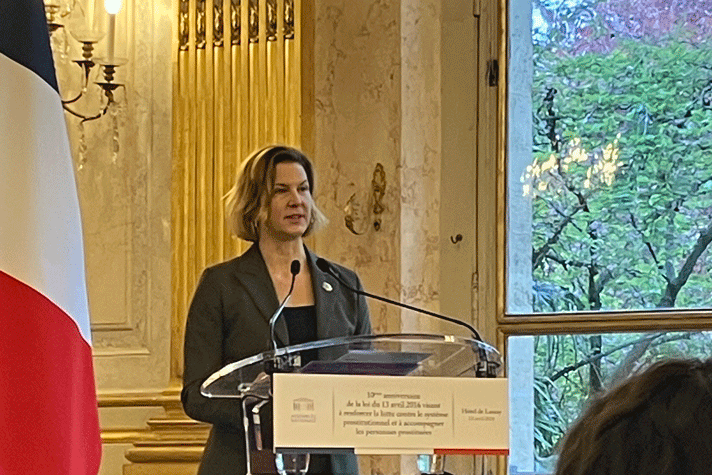
Ms. Nina Larsson, Swedish Minister for Gender Equality speaks at a conference in the French National Assembly on April 13.
Regeringskansliet
-
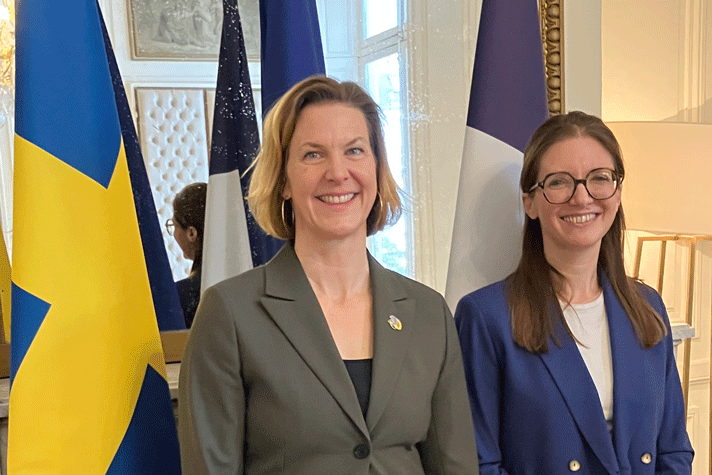
The Swedish and French Ministers for Gender Equality met in Paris in connection with the conference “Abolition in Action, 10th anniversary of French abolitionist law”.
Regeringskansliet
-
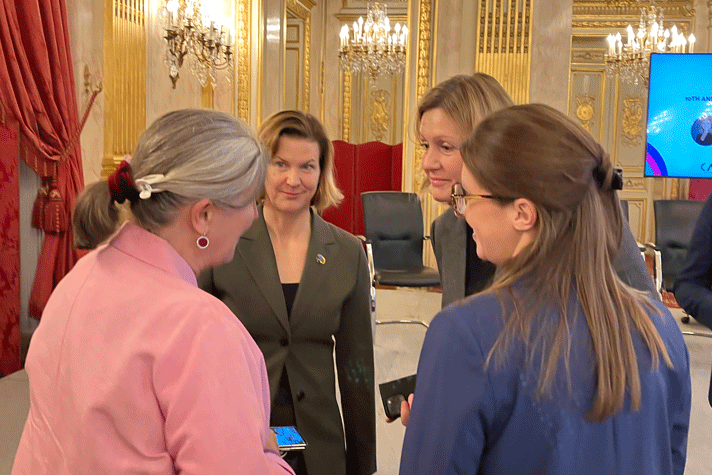
Sweden’s Minister for Gender Equality, Ms. Nina Larsson, the President of the French National Assembly, Ms. Yaël Braun-Pivet and France’s Minister for Equality between Women and Men and the Fight against Discrimination Ms. Aurore Bergé during the conference.
Regeringskansliet


Through legislation in both countries, France and Sweden have taken a clear position against normalizing prostitution as work. The common view is that prostitution should always be perceived as an exploitation of someone’s vulnerability and thus should never be considered a job. For this reason, the purchase of sexual acts but not the sale has been banned in both countries.
As France marks the ten-year anniversary of its abolitionist legislation, which was inspired by the Swedish model, the ministers from both countries met to learn from each other and to reaffirm their commitment to the joint French Swedish global strategy.
The partnership was introduced in 2019 and aims to reduce the demand for girls and women in prostitution, in Europe and globally. The reason for this is the clear nexus between trafficking for sexual exploitation and prostitution.
France and Sweden are both committed to fostering comprehensive inter-agency strategies and action plans in their own countries to tackle the challenge of human trafficking as well as to develop international cooperation in this area.
“Sweden has an opportunity to learn from France’s experience in implementing exit-programmes for persons exploited in prostitution which they introduced already ten years ago with the adoption of their legislation. Our laws must also keep up as the line between our physical and digital lives fades. Therefore, the purchase of sexual acts carried out remotely has recently been criminalised in Sweden. The provision has been amended to include sexual acts provided in or through the digital realm,” said Swedish Minister Nina Larsson.
"Prostitution is not the oldest profession in the world; it is one of the oldest systems of domination and exploitation of women. Behind seemingly ordinary façades, digital platforms, and narratives of freedom or autonomy, the reality remains the same: women and girls - often increasingly young - whose bodies are treated as resources to be exploited, controlled, and monetised. In the face of transnational criminal networks and evolving forms of recruitment and online sexual exploitation, it is imperative to build a strong coalition of States, in Europe and beyond, united by a shared vision: that prostitution constitutes the exploitation of human vulnerability. France and Sweden reaffirm a shared commitment to advance the abolitionist model, which protects those in prostitution by decriminalising them, while holding accountable those who create demand by purchasing sexual acts." said French Minister Aurore Bergé
