
The box of Tagore: a symbolic gift representing strong historical bonds
Published
At the invitation of the Prime Minister of Sweden, Ulf Kristersson, Shri Narendra Modi, the Honourable Prime Minister of the Republic of India, paid an official visit to Gothenburg, Sweden, on 17 May 2026. During the visit, Mr Modi was presented with a special gift symbolising the historic bonds between the two countries.
-
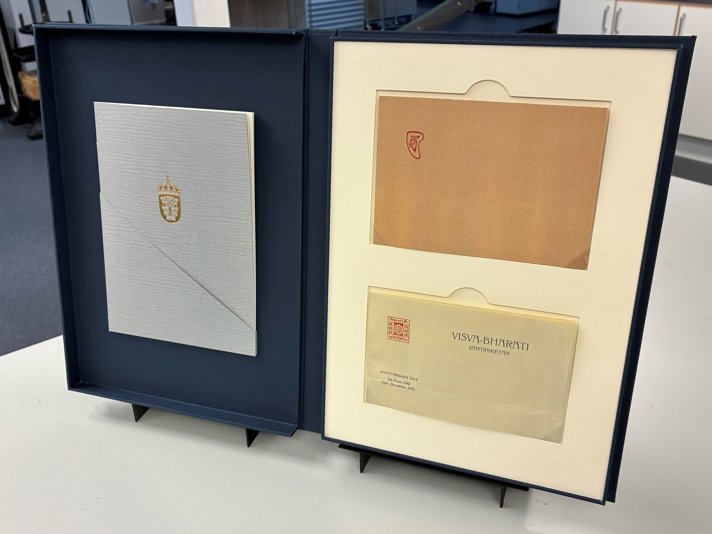
The symbolic gift contains faithful reproductions of two handwritten cards by the Indian poet and Nobel laureate Rabindranath Tagore (1861–1941).
Photo: The Swedish National Archives
-
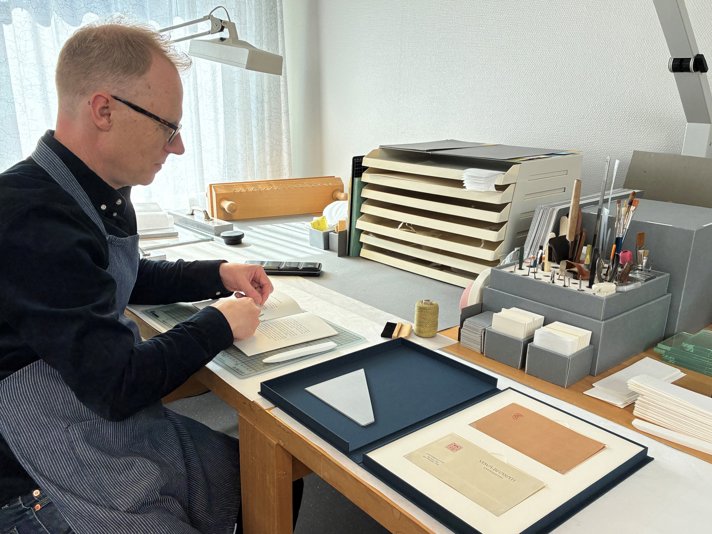
The verses were discovered in the Swedish National Archives, in a personal archive belonging to Sven Hedin (1865–1952), an author and explorer, who hosted Mr Tagore in Stockholm in 1921.
Photo: The Swedish National Archives


The symbolic gift – a cobalt-blue box adorned with gold lettering and a monogram – contains faithful reproductions of two handwritten cards by the Indian poet and Nobel laureate Rabindranath Tagore (1861–1941). In 1913, Mr Tagore became the first non-European to be awarded the Nobel Prize in Literature.
The box also contains a short text about Mr Tagore’s two visits to Sweden in 1921 and 1926, as well as a photograph from his visit to Uppsala University in Sweden in 1921.
The facsimiles consist of two verses, one written in both his mother tongue, Bengali, and English, and the other written in English. The texts read:
“God’s smile is revealed in love’s light which reveals brother’s face”
(Interpretation: happiness or blessing is to be found in one’s fellow human being, in the humanity and divinity that we all carry within us.)
“History slowly smothers truth but hastily struggles to revive it in a terrible penance of pain”
(Interpretation: the memory of the past becomes distorted over time, which may lead to a painful awakening when we are forced to realise how things really were.)
The verses were discovered in the Swedish National Archives, in a personal archive belonging to Sven Hedin (1865–1952), an author and explorer, who hosted Mr Tagore in Stockholm in 1921.
Rabindranath Tagore
Born in 1861 in Calcutta (today known as Kolkata) in Bengal, India, Rabindranath Tagore received the Nobel Prize primarily for the poetry collection Gitanjali (Song Offerings), which he himself translated from Bengali into English. His poetry was considered to unite Indian philosophy with Western tradition. He is still widely read and well-known today. In 2013, the centenary of his Nobel Prize was celebrated in Sweden and in many other parts of the world.
Mr Tagore has been described as a ‘Renaissance man’ thanks to his remarkable breadth and influence across many fields. He was not only a poet, but also a writer, composer, philosopher, painter and teacher, as well as an educational reformer.
Visits to Sweden in the 1920s
Mr Tagore was unable to travel to Sweden to receive his Nobel Prize in 1913 due to the First World War, but he travelled to Stockholm in May 1921 at the invitation of the Swedish Academy. His visit attracted considerable attention, and he was warmly received by both the public and the press. During his stay, Mr Tagore gave several lectures – including one in the university town of Uppsala – which drew large audiences. Mr Tagore also took part in many social and cultural events, and met prominent figures in Swedish cultural life, including writers, artists and scholars. His presence contributed to a growing interest in Indian literature and philosophy in Sweden.
Mr Tagore visited Sweden once more, for a few days in 1926. On that occasion he met with the Swedish Academy and read some of his poems on Swedish radio.
Images
Images of the gift, from the Swedish National Archives, are published in the Government Offices Media Bank.
Shortcuts
Strategic partnership between India and Sweden
On 17 May, Prime Minister Ulf Kristersson receives Prime Minister of India Narendra Modi in Gothenburg on the occasion of Sweden and India upgrading their bilateral relations to a strategic partnership.
