
Tough negotiations at COP30
Published
The UN Climate Change Conference (COP30) in Belém, Brazil concluded after overrunning into 22 November. Negotiations were characterised by disagreements between various countries, and did not result in the push to implement countries’ domestic climate plans that Sweden and the EU would have wanted.
-
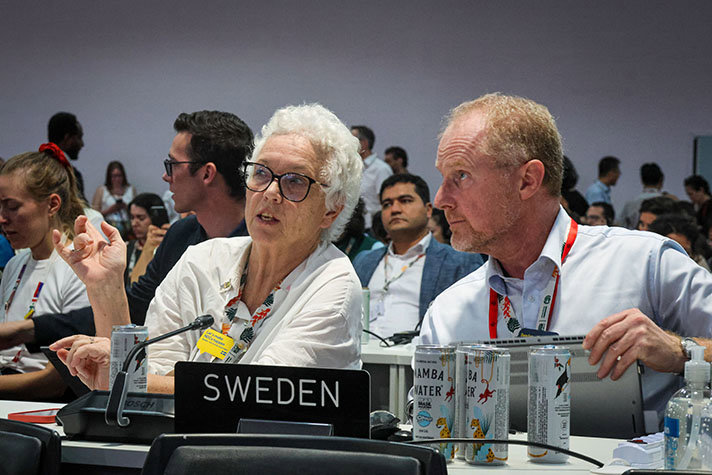
State Secretary Helena Dyrssen and Sweden's Climate Ambassador and chief negotiator Mattias Frumerie in the plenary.
Photo: Jonatan Klefbom, Government Offices of Sweden.
-
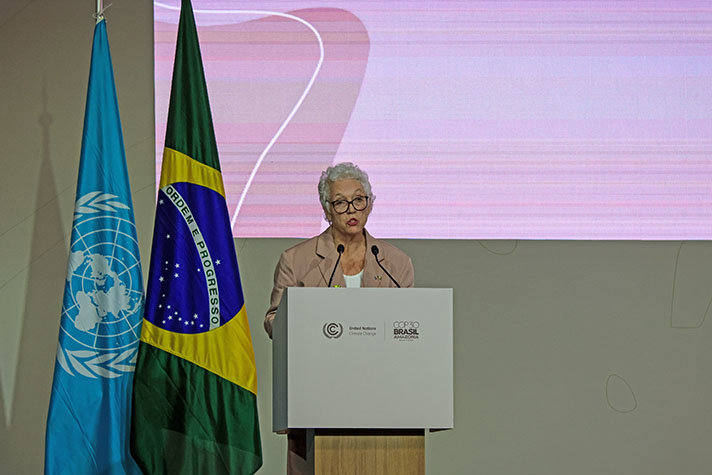
State Secretary for Climate and the Environment Helena Dyrssen delivered Sweden's national statement.
Photo: Jonatan Klefbom, Government Offices of Sweden.
-
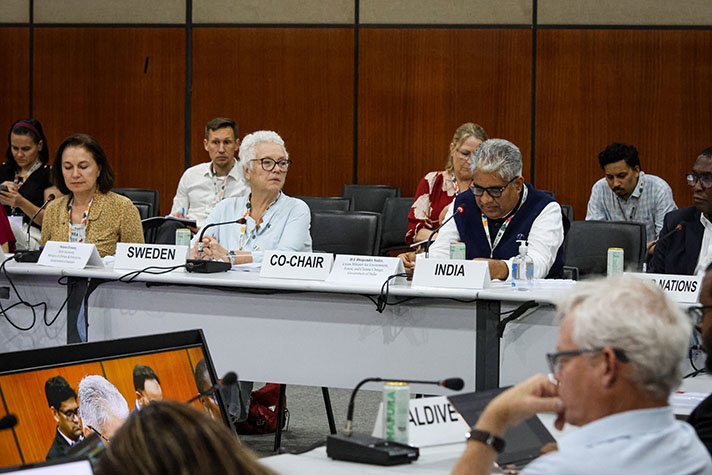
State Secretary Helena Dyrssen and India's Minister for the Environment Bhupender Yadav convened a high-level meeting, within the Leadership Group for the Industry Transition (LeadIT), of governments, industry and international initiatives
Photo: Jonatan Klefbom, Government Offices of Sweden.
-
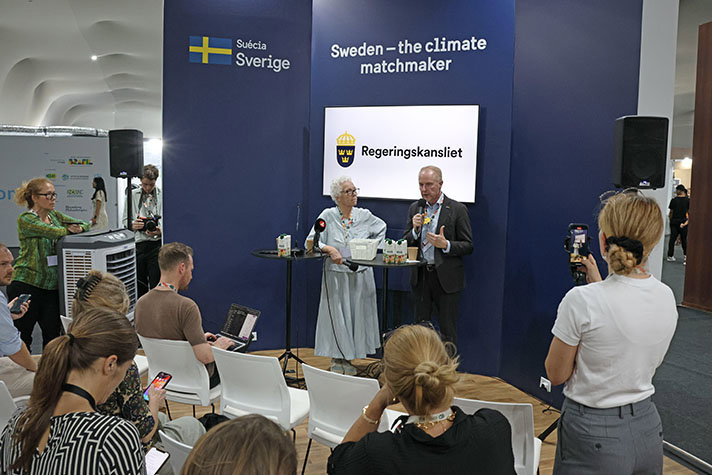
State Secretary Helena Dyrssen and Sweden's chief negotiator Mattias Frumerie at a press briefing in the Swedish pavilion.
Photo: Jonatan Klefbom, Government Offices of Sweden.


The 30th session of the Conference of the Parties was held in Belém, Brazil, from 10–22 November, with more than 56 000 participants. The Conference was due to end on 21 November, but typically overran and ended on the evening of 22 November.
Disagreements between countries evident
Sweden and the EU’s main priority at the Conference was to establish a robust process for the implementation of new national climate plans known as Nationally Determined Contributions (NDCs), which all countries were expected to present ahead of COP30. Not all countries submitted new plans, and a review of the plans that were submitted showed that emissions are expected to decrease by 10–15 per cent by 2035. However, the UN’s Intergovernmental Panel on Climate Change argues that emissions must be reduced by at least 60 per cent to limit global warming to 1.5 degrees Celsius.
The disagreements between countries that want to accelerate the transition to fossil-free energy and oil-producing countries became evident at COP30. The latter argued that the NDCs are decided domestically and thus should not be negotiated at climate conferences; while the EU acknowledged that the plans themselves should not be negotiated, but emphasised that the outcome of the Conference needed to relate to how the global community should address the gap in ambition and implementation that the new NDCs expose. Countries such as China and India also criticised regulations such as the EU’s Carbon Border Adjustment Mechanism (CBAM).
Dedicated process to address the ambition gap
The Brazilian presidency of the event, chaired by André Corrêa do Lago, established a dedicated process to address the ambition gap and CBAM, among other things. This resulted in the Conference deciding to produce two reports for COP31, the Global Implementation Accelerator and the Belém Mission to 1.5. In addition, a dialogue will be established on the opportunities and challenges of trade-related climate action, with the first dialogue to be held in Bonn in 2026. The result was disappointing for Sweden and the EU, but the EU still chose to support the proposal to safeguard multilateral cooperation.
Both Brazilian President Luiz Inácio Lula da Silva and Minister for the Environment Marina Silva wanted COP30 to agree to draw up a decarbonising roadmap based on the COP28 commitment to “transition away from fossil fuels in energy systems”. The proposal met with resistance, but during the final plenary the COP30 President pledged to develop a roadmap on decarbonisation by 2026, as well as a roadmap to tackle deforestation.
The amount of adaptation financing increases
Sweden and India are chairing the Leadership Group for the Industry Transition (LeadIT), and convened a high-level meeting of governments, industry and international initiatives to evaluate progress and lay the foundations for the next phase of global industrial cooperation.
COP30 also adopted a new action plan on gender equality. Sweden, through State Secretary Helena Dyrssen, and Chile were appointed by the COP30 President to lead the negotiations at ministerial level. These consultations helped the parties adopt a new action plan on gender equality and climate change, valid for nine years.
New action plan on gender equality and climate change
A decision on increasing the amount of adaptation financing was taken. The doubling that donors at COP26 were urged to achieve by 2025, will now be tripled to 2035, (equivalent to USD 120 billion). For the EU, it was crucial that an increase in adaptation funding should be made within the framework of last year’s decision on the new funding target.
Other decisions included the design of the new Technology Implementation Programme, some 60 indicators for climate adaptation, and a continuation of the dialogue on the transition of financial flows. Brazil also launched a new fund during the high-level meeting, the Tropical Forests Forever Facility.
It was also decided that COP31 will be held in Türkiye, with Australia chairing negotiations. Ethiopia will host and chair COP32.
Climate transition is urgent but offers opportunities
Sweden’s key drivers are urgency and opportunities, i.e. that according to the science the climate transition is urgent, but it also offers opportunities in the form of jobs and improved competitiveness.
The Swedish delegation was led by State Secretary Helena Dyrssen. State Secretary Diana Janse participated on 11–12 November. COP30 was preceded by a high-level meeting on 6–7 November with the participation of Their Majesties The King and Queen, as well as Minister for EU Affairs Jessica Rosencrantz.
The delegation included representatives of the Government Offices, the Riksdag, the Swedish Environmental Protection Agency, the Swedish Energy Agency, the Swedish Meteorological and Hydrological Institute, the Swedish Forest Agency and the Swedish International Development Cooperation Agency. For the fifth year in a row, Business Sweden hosted the Swedish pavilion, where more than 20 companies and government agencies held events and meetings on the theme Sweden – the Climate Matchmaker.
In addition to the negotiations themselves, the delegation participated in a large number of events to highlight the solutions that Sweden and Swedish companies can offer to accelerate the transition globally, in line with the main drivers of urgency and opportunities.
